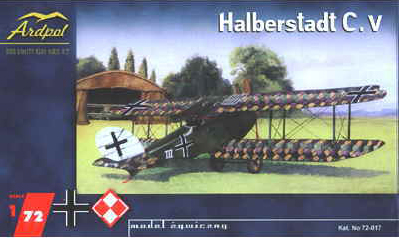
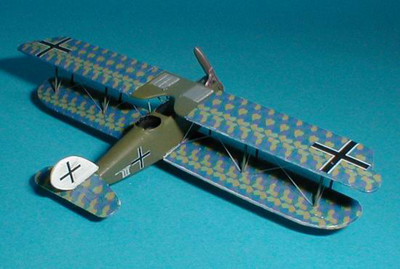
development and service history
The
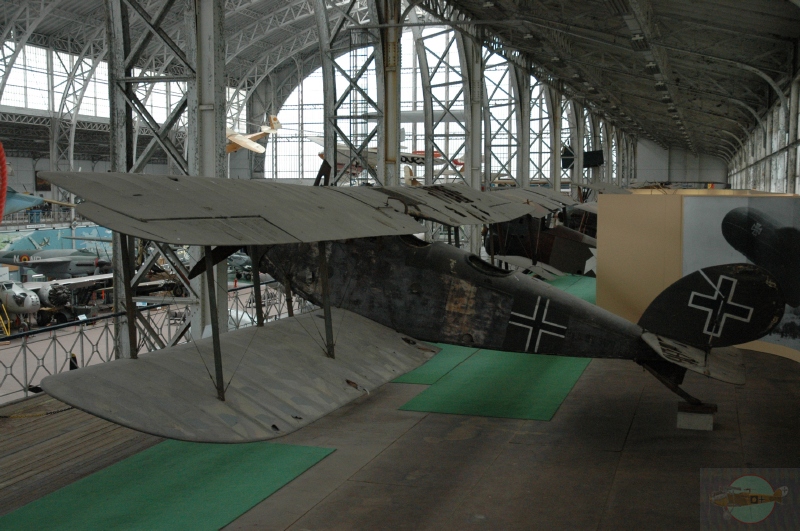
Halberstadt CV was a development of the CIV being designed by Karl
Theis as a short range photographic reconnaissance machine and
artillery spotter. Initially designed to carry a 250mm camera, it
could also carry 50kgs of bombs.
The Halberstadt CV was powered by the proven Benz IV engine
which was further modified for high altitude flying by raising the
compression in the cylinders with the designation Benz IVu, where the
"u" stood for uberkomprimiert (high
compression). The prototype made its maiden flight in March 1918 and
its superiority over other types in its class was immediately noted. It
had a good rate of climb (5000
metres in 24 minutes)and proved very manoeuverable in
flight.
Take off and especially landing proved problematic however, due in part
to the very short fuselage length (designed to reduce weight) and a
lack of strength in the undercarriage legs. Because of the short
fuselage, the aircraft had a tendency to "bounce" when landing
and this put an undue strain on the undercarriage legs which would
often collapse and in some cases flip the aircraft over.
Landing the CV
clearly called for a special technique on the pilots part. It is
interesting to note that of the few existing photographs of the period,
many show a Halberstadt CV having come to grief on landing.
Nevertheless the pilots who flew the aircraft liked it very much, not
just for its flight characteristics but also because of the protection
afforded by the deep fuselage sides and the good field of fire for the
observer mounted parabellum machine gun. |
specification
|
|
| Engine: |
200hp
Benz Bz IVu (The power rating of each engine varied slightly
from
aircraft to aircraft and this was usually stamped on the engine plate)
|
| Fuselage length: |
6.92 metres |
| Wings upper : |
13.62 metres |
| Wings lower : |
12.85 metres |
| Wing area : |
38.9 sq.metres |
| Weight laden : |
1360 kg |
| Weight unladen : |
930 kg |
| Max speed : |
180 kph |
| Climb rate: |
5000 metres in 24 minutes |
| Armament : |
Forward firing Spandau mg.
Rear firing Parabellum mounted on a ring in observer position. |
| Radio : |
Yes, send/receive? using a Morse key. (This must have required a very steady hand ! ) |
| Heated flying suits : |
Yes, electrical power
supplemented by engine driven generator. |
| Parachutes : |
Not known. |
|
|
|
|
|